On the felt
Beside the seat to act: how often the strategy takes each action, and its EV in big bets. Click an action to walk the line; Back and Start bring you home.
 RazzEdge
Get RazzEdge
RazzEdge
Get RazzEdge
Windows · macOS · Linux
RazzEdge Razz Poker Solver A–5 & 2–7Any street. Any situation. Up to 6 players.
A complete Razz poker solver for standard A–5 (ace-to-five) and 2–7 (deuce-to-seven) Razz. Set your own cards, ranges and betting, then solve every remaining street through to showdown.
Buy by email. No account or registration required.
Explore the opening
The first player folds 7♠. Compare the second player's strategy with 6♥ showing, using the same situation in A–5 and 2–7.
The table
7♠ has folded.
Q♥ posted the bring-in.
Read the strategy
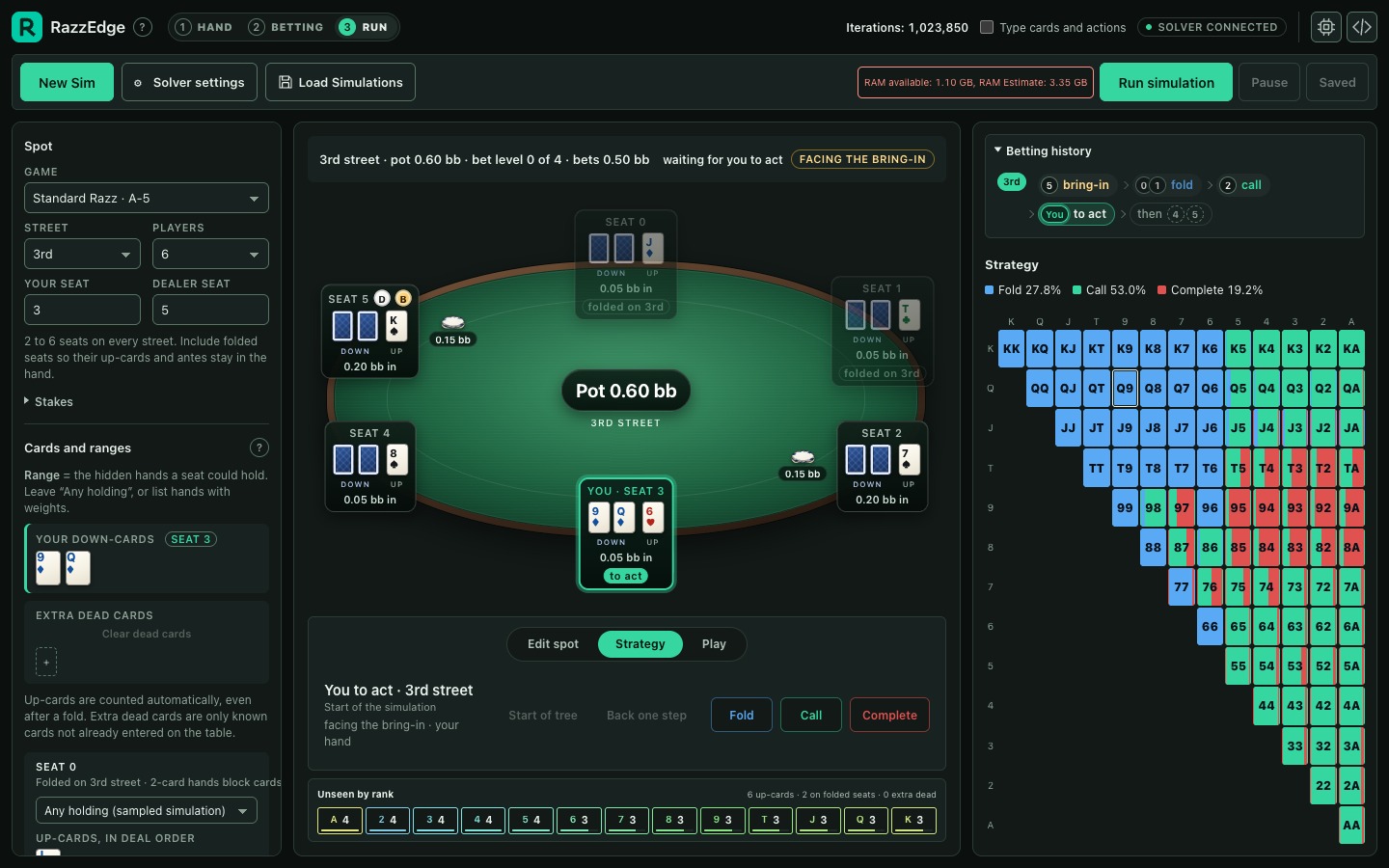
Beside the seat to act: how often the strategy takes each action, and its EV in big bets. Click an action to walk the line; Back and Start bring you home.
A 13×13 grid for the acting seat, coloured by action mix. Hover a cell for its suit combinations, each with frequency and EV.
The strategy refreshes every few seconds during the run. Pause, stop, save, and continue a saved run later.
Saved simulations live in a folder you choose. Copy one to share it; open someone else's and keep solving.
Trainer
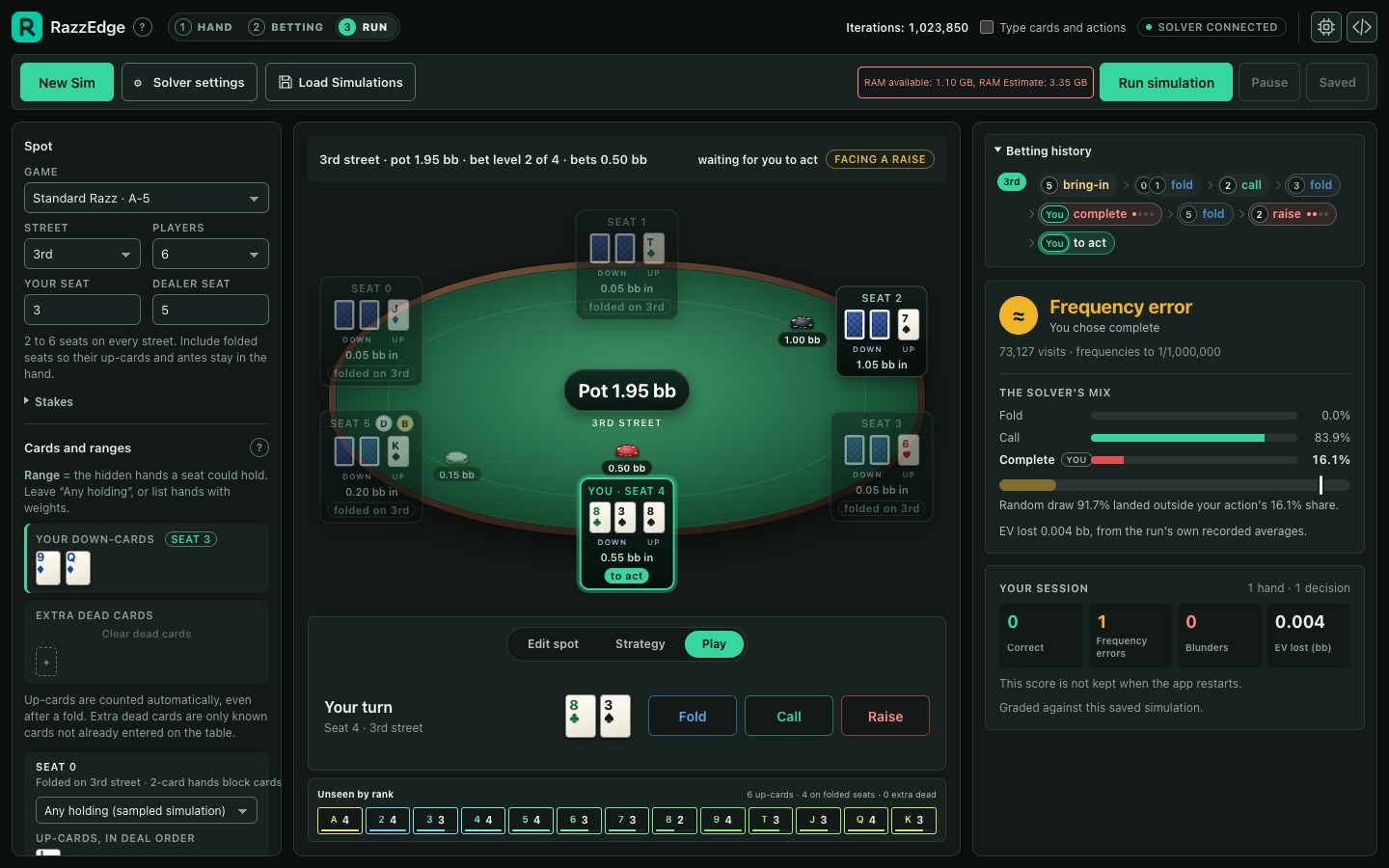
Deal a hand from the spot and take a random seat. Each decision is graded against the simulation, with the solver's mix, the draw, and the EV you gave up.
The solver's mix
Random draw 91.7% landed outside your action's 16.1% share.
EV lost 0.004 bb, from the run's own recorded averages.
Your session 1 hand · 1 decision
Whole hand
Create a fresh situation on 3rd, 4th, 5th, 6th or 7th street for two to six players. Choose the cards, set each seat’s range and enter the betting. The full solver works through the rest of the hand to showdown.
On your machine
Three- and four-player openings can fit on a laptop. Full five- and six-player openings need substantially more memory. These are current solver estimates for a fresh 3rd-street situation with every player still in, solving through to showdown.
Leave room for the rest of your computer. These figures include the solver’s working memory and runtime allowance, but not the operating system, desktop interface or other apps. A 32 GB machine has very little headroom for a 31 GB solve.
Starting on a later street or with fewer players still in can reduce the requirement substantially. The app estimates your exact situation before you run it. Saving only the opening street reduces the saved file size, not the RAM needed to solve the full hand.
Calculated from the current engine’s memory estimator for the full street-tree strategy, with uniform starting ranges, a four-bet cap, eight worker threads and the same working-buffer settings at each table size. Figures are rounded, use decimal GB, and are capacity estimates rather than measured peak usage. Cards, betting history and solver settings can change the result.
Pricing
Pick the Complete Solver for the full local engine, or the Edge Pack for ten browser and mobile simulations of your choice.
Email [email protected] to purchase RazzEdge. No account or registration required.
Edge Pack
$5,000 USD
Any 10 simulations
RazzEdge Complete Solver
$25,000 USD
One purchase · two licenses
Both Razz variants are included in each license. Pick the game when you create a situation: the hand rankings, board order and bring-in rule follow it, and each saved simulation stays tied to its game.
Standard Razz is seven-card stud lowball with ace-to-five hand rankings. Use the A-5 Razz solver to study starting hands, third-street openings and later-street betting against the ranges you enter.
Deuce-to-seven Razz uses the stud format with 2-7 lowball hand rankings. Use the 2-7 Razz solver to study how high aces, straights and flushes change your strategy. This is the Razz variant; 2-7 Single Draw and Triple Draw are separate games.
Questions
A Razz poker solver studies betting decisions for specified cards, player ranges and stakes. RazzEdge simulates the remaining hand and reports action frequencies and expected value (EV), then lets you practise those decisions in its trainer. It supports both standard A-5 Razz and 2-7 Razz, from third street through seventh street and showdown.
A Razz equity calculator estimates a hand's share of the pot at showdown against other hands or ranges. A solver also models betting decisions. RazzEdge shows how often its strategy folds, calls, checks, bets or raises where those actions are available, along with EVs, so you can study how to play a situation.
RazzEdge Complete Solver costs $25,000 USD for two licenses. Each license includes A-5 and 2-7 Razz, and the purchase includes three example simulations for 3rd street. The $5,000 Edge Pack includes any 10 simulations of your choice for any street with 2 to 6 players, available in your web browser and on mobile. Email [email protected] to purchase. No account or registration is required.
It runs a Monte Carlo (MCCFR) simulation of the whole remaining hand and shows action frequencies with EVs in big bets. Results are estimates with sampled intervals, not a proof of equilibrium. Run longer, and measure more hands, to tighten them.
No. Each seat's range is what you enter: any holding by default, or a list of hands with weights. Up-cards and folded seats are counted automatically.
Fixed-limit seven-card stud: ante, bring-in, completion, small and big bet, four-bet cap. Stakes are set per spot. All-ins, side pots and the paired-board double bet are not modelled.
Yes. Each saved simulation is a single file in a folder you choose. Copy it to someone else, or open theirs, and continue solving from where it stopped.
For full third-street starts with everyone still in, the current estimates are about 0.9 GB of solver RAM for 3 players, 3 GB for 4, 31 GB for 5 and 337 GB for 6. Allow additional RAM for the operating system, desktop interface and other apps. Later streets and fewer active players can need much less. The app estimates each situation before it starts.